The Workbench
2026–27 Allure Hockey: Color Flow, New Inserts and Hobby vs. Blaster
Luke the Cardist’s Color Flow artwork returns alongside Attack Mode, Shut The Door and Impressions. Hobby and Blaster take different routes through the rainbow.
We update this release guide as verified product details develop.

Allure’s Color Flow cards are built to be seen together. For 2026–27, Upper Deck returns to artwork by Luke the Cardist, with five colour transitions that can be arranged into a player rainbow. Each version uses a different image, so completing the sequence changes more than the border around the same photograph.
Around that signature idea, Allure adds Attack Mode, Shut The Door and the original-art Impressions set. Hobby supplies eight eight-card packs and an autograph-or-Doubloons box average. Blaster is a smaller four-pack format with its own Glitter Bomb and Pink Spectrum parallels.
Hobby and Blaster release dates
The current Southern Hobby schedule estimates December 16, 2026 for Hobby. Blaster is a separate late-December release: Steel City estimates December 30, while Southern lists December 31. Neither is a confirmed manufacturer opening time.
Steel City’s Hobby preorder is $129.95 per box. That is a dealer asking price, rather than an announced Upper Deck MSRP.
| Format | Packs × cards | Advertised box focus |
|---|---|---|
| Hobby | 8 × 8 | 1 autograph or Doubloons; 8 Color Flow cards, on average |
| Blaster | 4 × 5 | 2 rookies and 2 Black, Red or Orange Rainbow parallels, on average; exclusive Glitter Bomb and Pink Spectrum parallels |
The format difference is substantial. Hobby contains sixty-four cards, while Blaster contains twenty. Hobby is also the configuration advertising a regular Color Flow sequence-building opportunity and an autograph-or-Doubloons average. Blaster’s particular attraction is its exclusive parallel treatment, rather than the same opening reduced to four packs.
Color Flow builds a five-card player picture
The five stages run Red–Orange, Orange–Yellow, Yellow–Green, Green–Blue and Blue–Purple. Upper Deck describes a checklist of more than twenty players, mixing veteran stars and rookies, with one Color Flow card per Hobby pack on average.
The appeal is unusually specific to the set. Arranged in order, one player’s cards form a progression through the colours, and the changing images make the run feel like a small illustrated collection. A collector can pursue that five-card sequence without needing to complete every player in the insert set.
There is a numbered version of that project too. Spectrum parallels run /299 for Red–Orange, /199 for Orange–Yellow, /99 for Yellow–Green, /50 for Green–Blue and /25 for Blue–Purple. Golden Treasures 1/1s sit beyond that sequence, while Color Flow Full Rainbow Autographs offers a separate signed treatment.
Those numbering changes also explain why the Spectrum player rainbow is a different undertaking from the standard run. The five colours do not have matching production limits. A Blue–Purple Spectrum card is the /25 end of that progression, rather than merely another equally available colour.
A 150-card base set, including fifty rookies
The manufacturer’s product breakdown specifies 100 veteran cards numbered 1–100 and fifty rookies numbered 101–150. That is a 150-card base set. Hobby averages one base rookie per pack.
Black Rainbow, Red Rainbow and Orange Rainbow provide the recurring unnumbered colour treatments. The numbered base ladder includes Blue Spectrum /299, Gold Glitter Bomb /199, Green Spectrum /99, Foliage /75, White Spectrum /50, Tile /25, Purple Spectrum /10 and Golden Treasures 1/1.
For a player collection, this gives Allure both colour-based and pattern-based choices. Tile and Foliage are separate visual treatments within the same numbered ladder, so the most attractive example need not simply be the lowest number. Blaster’s exclusive Glitter Bomb and Pink Spectrum cards add another format-specific branch.

Attack Mode, goalies and original art
Attack Mode concentrates on top forwards, while Shut The Door gives goalies their own insert identity. They join Hues Next?, allowing the insert mix to do more than repeat the full base checklist in a different frame.
The product breakdown gives Hobby pack odds of 1:5 for Attack Mode and 1:7 for Shut The Door and Hues Next?. All three also have Purple Spectrum /125, Orange Spectrum /25 and Golden Treasures 1/1 versions. These are different player-focused routes through Allure: scorers, goaltenders and the Hues Next? selection each get a recognisable collecting lane.
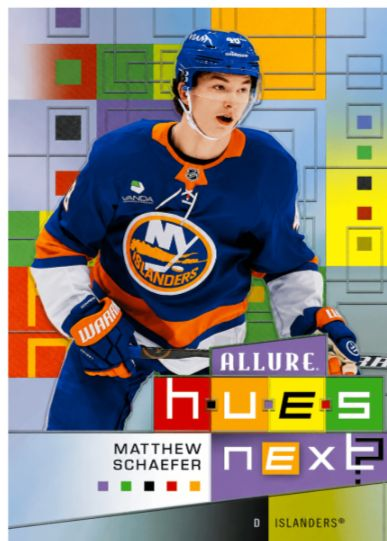
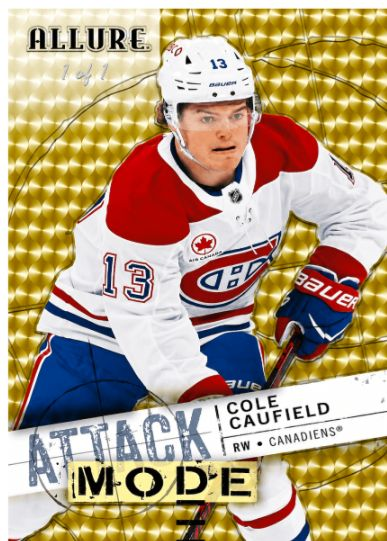
Matthew Schaefer’s Hues Next? sample stacks blocks of colour behind his Islanders portrait, carrying the geometric motif through the lettering. Cole Caufield’s Attack Mode takes a louder route, with bold title lettering and a gold patterned field behind his skating image.
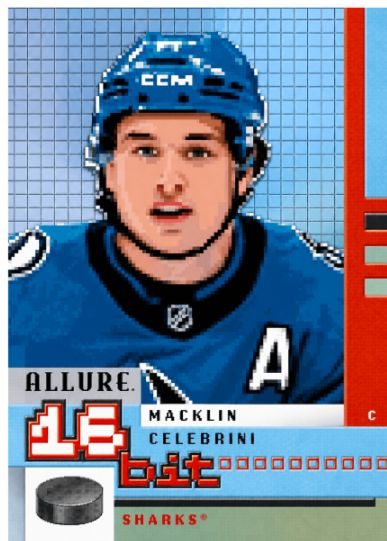
Impressions is a ten-card original-art set advertised at 1:1,440 Hobby packs. Hypnosis is listed at 1:1,152, and 16-Bit at 1:960. Those are pack odds, not published total print runs. The Impressions artwork in particular extends the illustrated character of Color Flow into a much smaller, scarcer insert checklist.
The Connor McDavid Impressions sample at the top of this guide uses a painted portrait and warm orange strokes, with the Oilers jersey tying the palette to its subject. Macklin Celebrini’s 16-Bit sample goes all the way into pixel art, right down to the blocky helmet and face. These are two genuinely different visual ideas within Allure’s rare-insert program.
The autograph mix—and why Doubloons matters
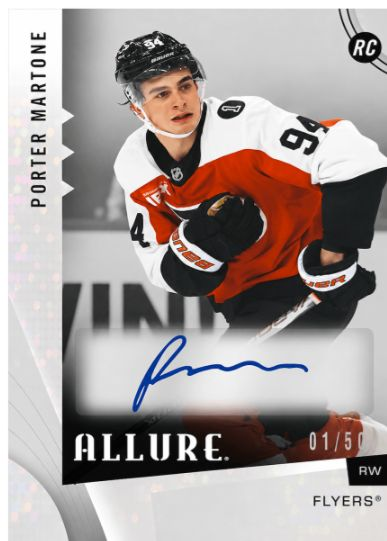
Hobby’s advertised main-hit average is one autograph or Doubloons card, so an autograph is not promised in every box. Doubloons is itself an insert chase, with the product table listing it at 1:72 Hobby packs.
Rookie Red Rainbow Autographs are listed at 1:32 Hobby packs, with veteran versions at 1:40. The signed parallel ladder includes White Spectrum /50, Foliage /35, Tile /25, Purple Spectrum /10 and Golden Treasures 1/1; rookies also have Green Spectrum /99. Those autograph numbers should be read separately from the unsigned base ladder—Foliage, for example, is /35 as an autograph and /75 as an unsigned base parallel.
A complete final player-by-player checklist is still to come. The product already gives collectors a useful choice, though: build the five-card Color Flow story, follow a favourite player through the patterned parallels, or concentrate on the smaller illustrated and autograph sets. Allure’s strongest feature is how differently those projects can look while still belonging to the same release.