The Workbench
EPOCH Career Achievement 2026: Japanese Baseball Legends and New Autograph Designs
Yoshinobu Takahashi, Suguru Egawa and Daisuke Matsuzaka appear in the official preview, with signed baseball cards, paired autographs and Tribute to the Past designs.
We update this release guide as verified product details develop.
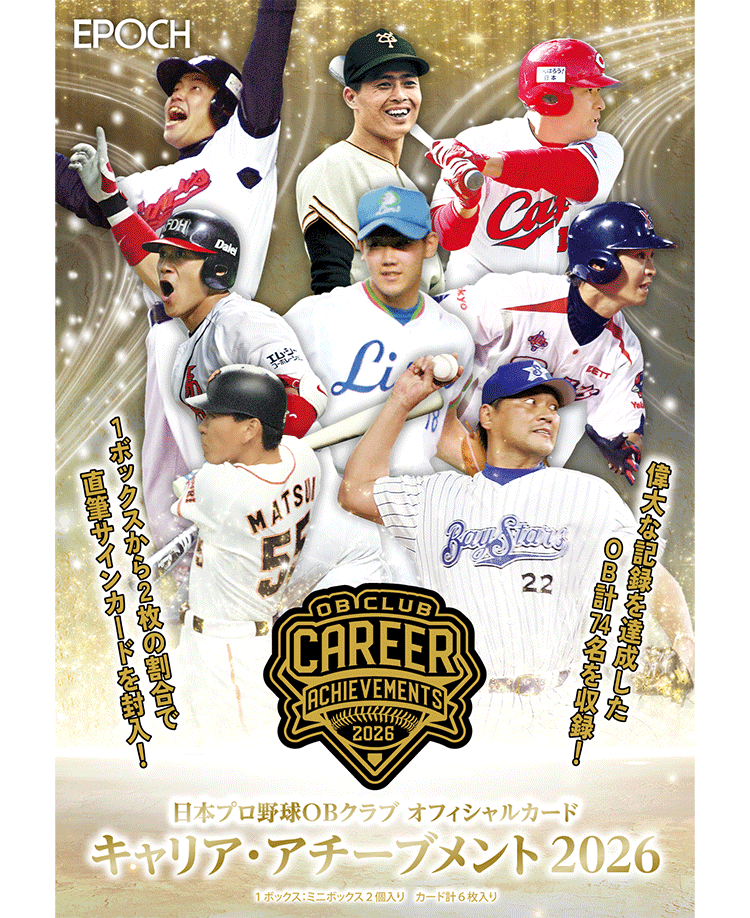
Yoshinobu Takahashi’s autograph, Suguru Egawa’s black-and-gold Baseball Greats card and Daisuke Matsuzaka in Lions colours give EPOCH’s Career Achievement preview a strong starting lineup. This is a release built around retired Japanese baseball players, with several autograph designs giving those careers different treatments.
The printed product is Career Achievement 2026, but its expected Japanese release is January 30, 2027. That distinction belongs at the start of the guide: the year on the cards and the year collectors are expected to receive the release are different.
Release date, box size and Japanese MSRP
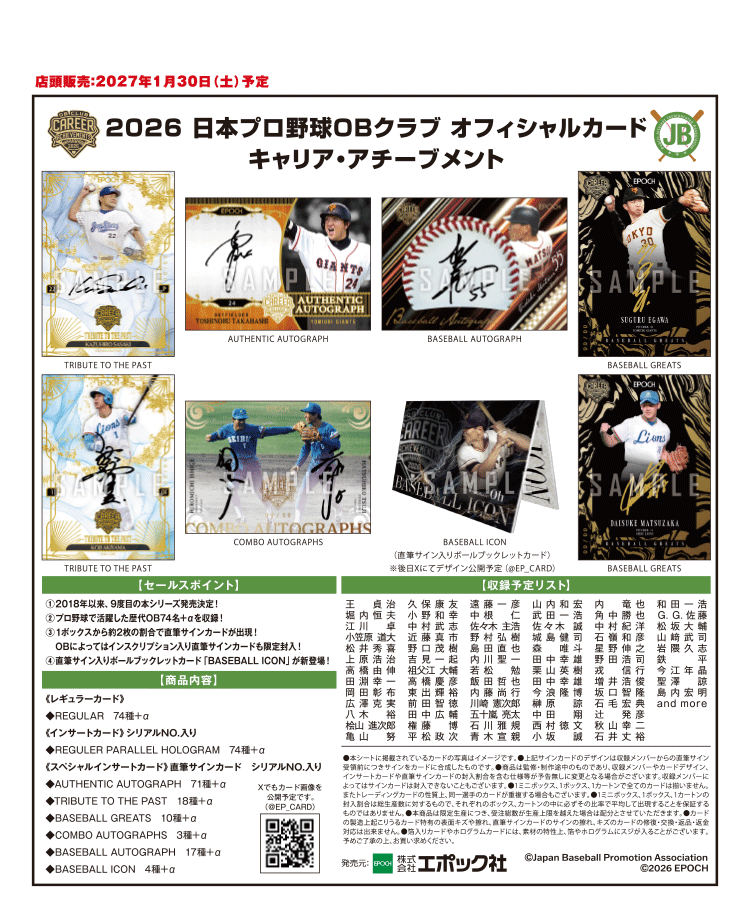
The official EPOCH product page lists a six-card box containing two mini boxes. Its Japanese manufacturer suggested retail price is ¥18,150 including tax, or ¥16,500 before tax. A twelve-box carton is ¥217,800 including tax.
| Product detail | Manufacturer announcement |
|---|---|
| Expected Japanese release | January 30, 2027 |
| Cards per box | 6 |
| Mini boxes per box | 2 |
| Japanese box MSRP | ¥18,150, including tax |
| Boxes per carton | 12 |
| Autograph frequency | Approximately 2 per box, on average, in the promotional sheet |
The autograph figure is an average, rather than a two-signature guarantee for every box. The Japanese MSRP is also distinct from any later imported-box asking price in another currency.
A retired-player checklist with several signature identities
EPOCH plans 74-plus regular card types, accompanied by serial-numbered Hologram parallels. The autograph menu is more varied than one portrait card repeated in a succession of colours.
Authentic Autograph has 71-plus planned types. Tribute to the Past has eighteen-plus, Baseball Greats ten-plus, Combo Autographs three-plus, Baseball Autograph seventeen-plus and Baseball Icon four-plus. Those are the manufacturer’s provisional category counts, not print runs or the number of those cards promised in a box.
The initial samples show how different those categories look: Takahashi receives a light action-and-signature design, Egawa and Matsuzaka appear against black and gold, and the Combo Autographs sample pairs two Lions players on one horizontal card. The complete checklist will identify the full subject list in each family.
Takahashi, Egawa and Matsuzaka in the first preview
Yoshinobu Takahashi’s Authentic Autograph sample pairs a Giants action photograph with a broad, pale signature area. The image and autograph have their own space, while the gold treatment ties them together. It is a direct, player-and-signature presentation within a release that also explores more elaborate constructions.
The Baseball Greats previews for Suguru Egawa and Daisuke Matsuzaka go in another direction. Dark backgrounds and gold lettering make the pale uniforms and signature treatment stand out. The two samples also preserve their different team identities, rather than making the card’s ornament more prominent than the player.
EPOCH marks the images as samples. They establish the announced designs and pictured subjects, while leaving the finished cards’ exact serial numbering and final production details to the complete release information.
Baseball Autograph, Baseball Icon and paired signatures
The Baseball Autograph preview makes a signed baseball the visual centre of the card. Its curved surface and stitching give the signature a different setting from a flat white panel. The manufacturer also introduces Baseball Icon, described in the promotional sheet as a signed-baseball booklet card.
Combo Autographs supplies the paired-signature route, with two players and two signatures in the official sample. Here, the relationship between the selected subjects becomes part of the card’s appeal. The exact pairings will be a useful part of the full checklist, particularly for collectors following one club or an era of its pitching staff.
Tribute to the Past adds another visibly distinct treatment, using ornate light-and-gold framing in the initial samples. Together with the darker Baseball Greats designs, it gives Career Achievement contrasting presentations for its retired-player subject.
January’s release is already worth following for those specific choices: Takahashi’s spacious autograph layout, the Egawa and Matsuzaka Baseball Greats samples, and the signed-baseball and paired-signature constructions. EPOCH has announced enough to show what the collection wants to celebrate, with the full checklist still needed to map every autograph type to its player.