The Workbench
2026 Panini Three and Two Baseball: Triple Autographs and Downtown
Skenes, Bazzana and Willits give the triple-autograph chase a clear connection, while detailed Downtown scenes and expansive patches add other collector targets.
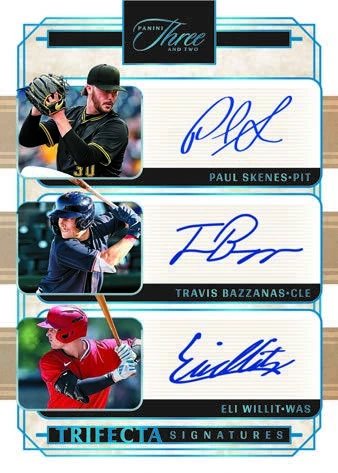
Paul Skenes, Travis Bazzana and Eli Willits share a Trifecta Signatures card in 2026 Panini Three and Two Baseball. It is a triple autograph with a particularly satisfying connection: the first overall picks from three consecutive drafts. That pairing of card design and baseball history is the strongest reason to start here, with Downtown illustrations, large patch autographs and a 150-card base set supplying several different directions beyond the headline signatures. Panini’s 2026 previews
Expected release and the five-card hobby box
Dave & Adam’s lists hobby boxes at $399.95, with an expected October 28, 2026 release. Those are dealer presale details. Each box contains one five-card pack, with an encased autograph and an encased memorabilia card among the advertised contents. Three and Two therefore gives a collector very few cards per opening, with the main focus on the individual autograph and memorabilia designs. Dealer box listing
| Hobby box | Contents, on average |
|---|---|
| Packs and cards | 1 pack, 5 cards |
| Autograph | 1 encased card |
| Memorabilia | 1 encased card |
| Other cards | 3 base cards or inserts |
| Boxes per case | 10 |
That format makes the specific autograph set unusually important to the character of an opening. Trifecta Signatures offers three players on one front; Jersey Autographs devotes substantial space to a patch; Timeless Moments leaves more room for a baseball photograph. They are all autograph targets, but they give the collector different things to appreciate once the card is out of the box. Hobby and autograph program
Three consecutive No. 1 picks make Trifecta more than a name count
Panini advertises triple on-card autographs in Trifecta Signatures. The Platinum preview arranges Skenes, Bazzana and Willits in three horizontal rows inside a vertical card. Each player gets a photograph at left, handwriting at right and a name beneath. The repeated layout gives the signatures comparable space, while the three different uniforms keep the players visually distinct. A pale background helps the blue ink remain readable across all three panels. Trifecta preview
Skenes was the first overall pick in 2023, Bazzana in 2024 and Willits in 2025. Their grouping consequently represents a sequence of drafts rather than a random collection of promising names. For someone collecting baseball’s next generations, the card records three successive organizations’ choices at the top of the draft. The three-row design reinforces that connection: each player occupies his own place in a small chronological collection, all joined by the same on-card autograph format. Skenes selection, Bazzana selection, Willits selection
Bobby Witt Jr. gets two very different autograph treatments
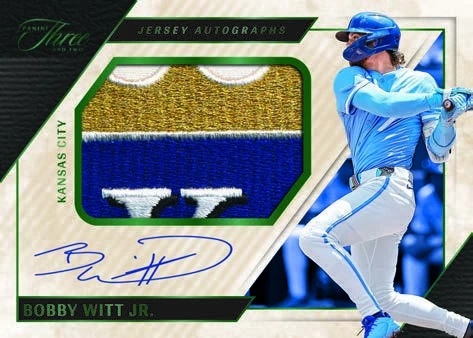
Witt’s Jersey Autographs Emerald places a large patch window across the left side of a horizontal card. His batting photograph occupies the right, and his signature follows the lower edge of the material. The gold, blue and white patch detail gives the preview texture that works with the pale background and dark green frame. This is an autograph design in which the material is a major visual subject, with Witt’s swing balancing the window rather than being compressed above it.
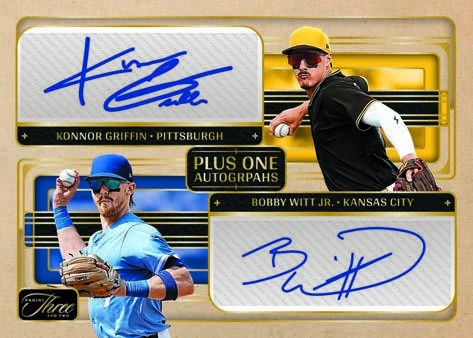
The Plus One preview pairs Witt with Konnor Griffin and swaps the patch for a second player. Griffin’s photograph sits at upper right with his signature at upper left; Witt receives the opposite arrangement below. Both are pictured with gloves, giving the pairing a fielding theme within the photograph selection. The gold-and-black lines link the two halves, while large light autograph panels keep the handwriting separate from the player images. It is a more conversational composition than the neatly stacked Trifecta, with the two players effectively facing into a shared card.
Downtown builds three distinctive places around the hitters
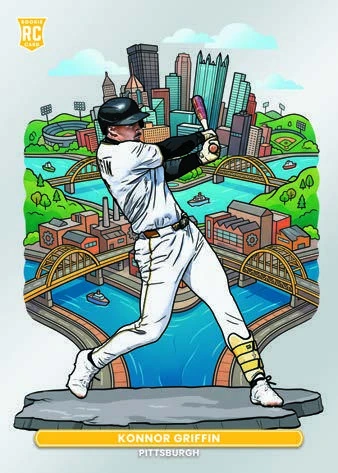
Griffin’s Downtown fills the space around his swing with Pittsburgh’s bridges, water and skyline. The rivers curve behind his legs, while the bridges create horizontal bands leading into the city. His gray uniform keeps the hitter distinct from the colorful setting. For a Pittsburgh collection, the appeal extends beyond Griffin’s name: the illustration makes the city part of the card’s identity, giving it a different purpose from the fielding photograph on Plus One.
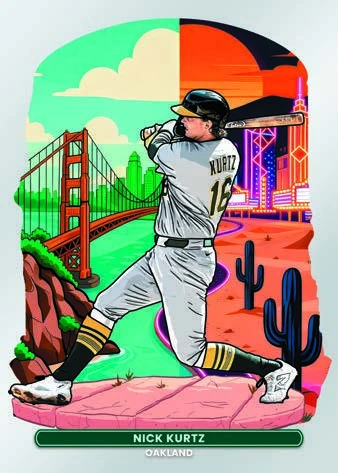
Nick Kurtz’s Downtown divides its backdrop into sharply different halves. A red suspension bridge and green hillside sit on one side; desert colors, cactus shapes and an illuminated city fill the other. The Oakland nameplate remains below the player. The result is a more layered visual composition than a single skyline, with Kurtz’s figure joining two settings. The preview is worth examining closely because those contrasting environments are central to its design, not incidental decoration.
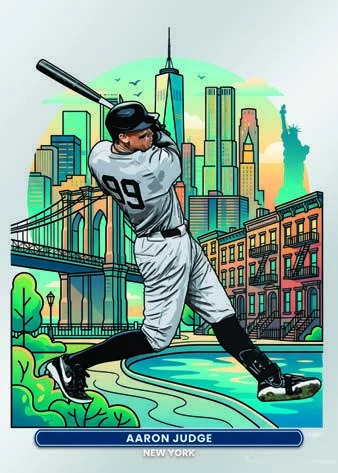
Judge’s version is the most immediately legible of the three. His number 99 faces the viewer as he finishes a swing against a New York skyline, with a broad bridge crossing the middle of the image. The long bat and angled stance interrupt the upright buildings, keeping the player dominant. Panini identifies Downtown as ultra-rare and also announces Blank Slate. A complete player checklist and exact insertion odds are still to come. Insert program
Roman Anthony’s patch and Bumgarner’s photograph change the emphasis
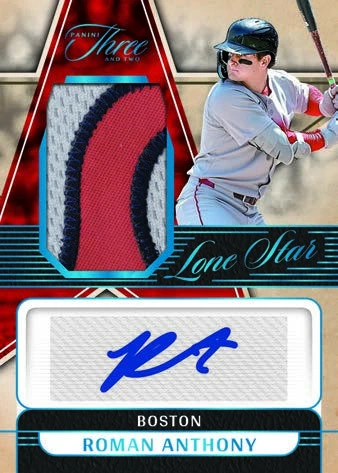
Roman Anthony’s Lone Star Signature Swatches is vertical, with the memorabilia window running alongside his batting photograph. The previewed fabric has broad red, dark blue and white areas, which echo the dark frame and pale autograph panel below. Its angular window gives the material a different shape from Witt’s broad rectangular patch. For a collector comparing the two, Anthony’s card emphasizes a long vertical patch beside the player; Witt’s lets the fabric stretch across the card.
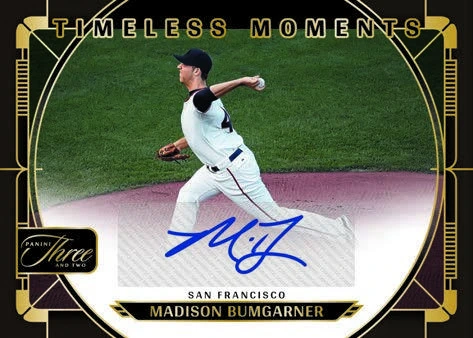
Bumgarner’s Timeless Moments Holo Gold relies on one photograph: the pitcher extended through his delivery, with the mound and grass still visible around him. The signature rests over the lighter lower section, leaving the throwing arm and upper body clear. Compared with the segmented patch layouts, this card gives baseball action more of the front. The wide photograph and simple gold outline suit a collector who wants the signature connected to an image of the pitcher at work.
Kevin McGonigle’s base preview keeps the photograph substantial
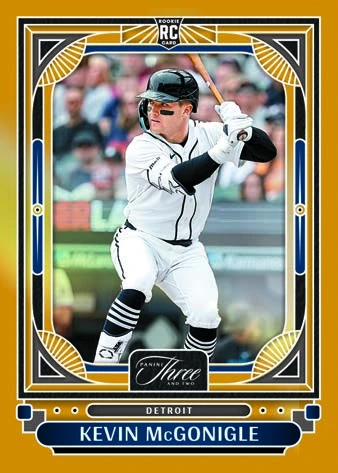
The 150-card base set includes prospects, rookies and legends. Kevin McGonigle’s Holo Gold preview shows a full batting stance inside a gold-and-black border, with a rookie shield at the top. The photograph extends far enough down to preserve his striped socks and lower-body positioning, giving the card more baseball detail than a tightly cropped torso portrait. It is a useful reminder that Three and Two’s base program has a photographic appeal alongside the more elaborate autograph and illustrated-card designs. Base preview