The Workbench
2026 Panini Track Kings NASCAR: Dale Jr. Autographs and Blank Slate
NASCAR gets a new card collection built around driver portraits, paint schemes and an unusually broad range of artistic treatments.
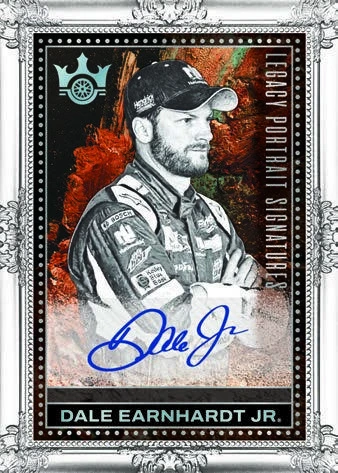
Dale Earnhardt Jr.’s Legacy Portrait Signatures card looks like a racing portrait that happens to carry an autograph. A monochrome driver photograph sits inside a detailed silver frame, with the blue signature crossing a pale panel beneath his folded arms. That is the appeal of 2026 Panini Track Kings NASCAR: a new release willing to give a driver, a race car and a memorabilia card very different visual identities. Panini card previews
Expected release and the ten-card hobby box
Dave & Adam’s has hobby boxes on presale for $124.95, with an expected October 9, 2026 release. That is the retailer’s price and schedule; Panini’s own product page currently says Coming Soon. The format makes Track Kings a compact opening, with one ten-card pack supplying the driver portraits, inserts and memorabilia that define this debut. Dealer box listing, Panini product page
| Hobby box | Contents, on average |
|---|---|
| Packs and cards | 1 pack, 10 cards |
| Autographs or memorabilia | 3 total |
| Inserts or parallels | 3 |
| Short-print base slot | 1 Base II/III or Base Cars II/III |
| Boxes per case | 16 |
The combined autograph-or-memorabilia allocation is particularly relevant here because the two categories offer different attractions. Earnhardt’s portrait puts his signature at the center of the card; William Byron’s Art Nouveau turns a memorabilia window into part of an elaborate illustrated frame. A Track Kings opening can therefore lean toward signatures or toward race-worn material while still delivering its advertised hit total. Hobby configuration
Driver portraits and race cars share the base set
The 200-card base program gives the cars substantial space of their own: 50 regular driver cards, 50 Base Cars and four short-print groups of 25 covering drivers and cars in tiers II and III. This creates two genuinely different ways into the release. A driver collector can follow a person across portrait treatments, while a paint-scheme collector has a dedicated set of machines to pursue. Base structure
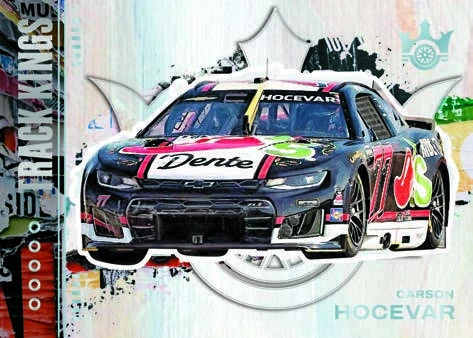
Carson Hocevar’s Base Cars preview shows why the horizontal format works. The No. 77 car fills most of the width, preserving the relationship between its black bodywork, bright numbers and hood graphics. The pale collage behind it suggests a wheel and garage imagery without competing with the car’s silhouette. Connor Zilisch’s Red and Blue base parallel takes the opposite approach: a full-length driver portrait, a large wheel motif and broad blocks of color. They feel related without making the vehicle card a substitute portrait.
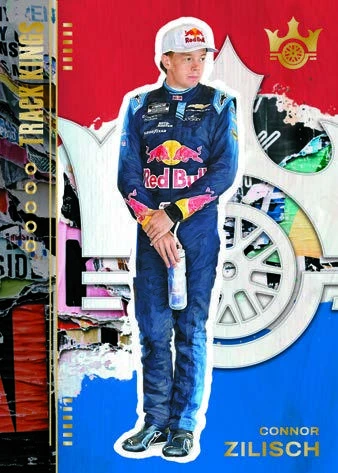
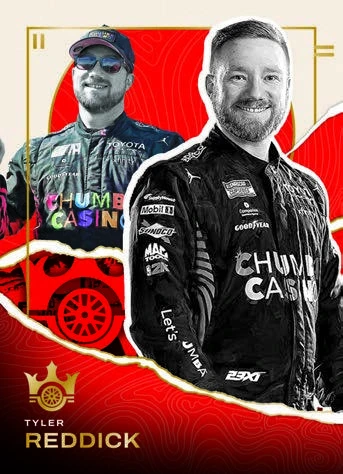
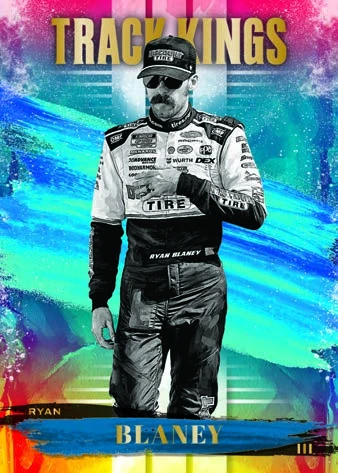
The higher base tiers change the composition again. Tyler Reddick’s preview combines two portraits over a red background, while Ryan Blaney stands against broad turquoise, blue and pink brushstrokes. These are useful differences for a driver collection: the short-print treatment offers another photograph and visual approach, rather than relying entirely on a different border color.
Dale Jr.’s signature earns the portrait treatment
Legacy Portrait Signatures is a ten-card autograph set. Earnhardt’s Canvas example keeps his face, shoulders and folded arms together above the signature, with the dark background and silver ornament doing most of the framing. The autograph remains easy to read because it crosses a lighter area. It is a particularly successful solution for a card whose appeal depends on both recognizing the driver immediately and seeing the signature clearly. Autograph preview
Earnhardt’s two Daytona 500 victories, in 2004 and 2014, give that portrait a substantial racing story. For a collector whose strongest Dale Jr. memories are tied to Daytona, the card offers a direct autograph connection to a two-time winner without reducing his identity to one car photograph. The reserved pose also suits the retrospective character of Legacy Portraits; this is a career subject, presented with room for the person behind the race results. NASCAR’s Daytona retrospective
Race-worn material takes two different shapes
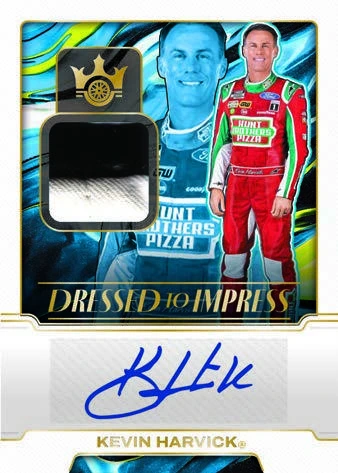
Dressed to Impress Material Signatures pairs race-worn or race-used memorabilia with autographs across a 25-driver set. Kevin Harvick’s Gold preview uses a small memorabilia window beside a full-length portrait and a larger blue-tinted headshot. The signature gets a separate white area below them. That arrangement gives each component a defined job: the two photographs establish Harvick, the window supplies texture and the lower panel gives his handwriting breathing room. Panini memorabilia details
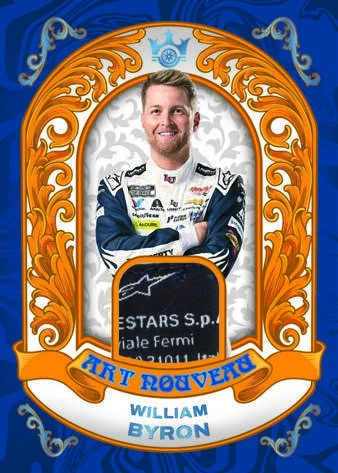
Byron’s Art Nouveau Masterpiece is more decorative. Orange scrollwork surrounds his portrait and a memorabilia window, set against a deep blue background. The material becomes part of the central portrait panel rather than a separate block below it. Panini’s Art Nouveau selection spans multiple NASCAR series, including Kaden Honeycutt and Sam Mayer alongside Byron. That breadth gives collectors following drivers up the racing ladder a memorabilia program extending beyond the Cup field.
Richard Petty and Chase Elliott show the insert range
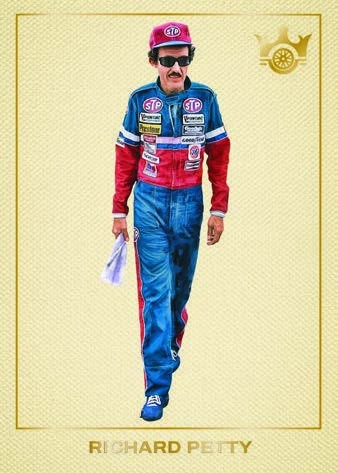
Richard Petty’s Blank Slate is the quietest preview in the release. His full-length figure stands against a pale background, with the red-and-blue racing attire, sunglasses and mustache carrying the recognition. Petty’s 200 Cup victories and seven championships make him a natural anchor for the collection’s historical side. The spare treatment works because his appearance is already so distinctive; the card does not need a busy racing scene to establish its subject. NASCAR Hall of Fame profile
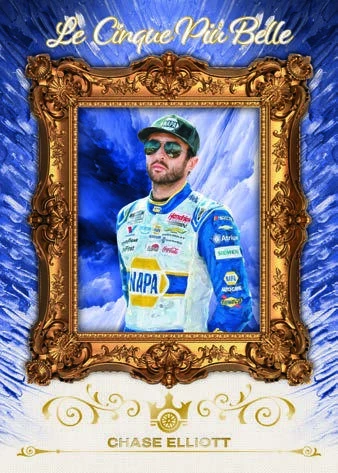
Chase Elliott’s Le Cinque Piu Belle goes gloriously ornate: a gold picture frame encloses his blue-suited portrait against a swirling blue surround. Beside Petty’s nearly empty background, it makes the range of Track Kings immediately apparent. Panini classifies both designs among four ultra-rare insert families, alongside Blackout and Aurora. Their attraction is visible in the cards themselves, even before a complete checklist or precise insertion odds arrives. Insert previews