The Workbench
2026 Topps Triumphant Tennis: November 17 Release and Card Design Review
Triumphant arrives November 17 with player-first photography, readable signatures and landmark tennis history.
We update this release guide as verified product details develop.
2026 Topps Triumphant Tennis is available November 17, following its September 18 preorder. The card previews make a clear case for player-first photography, broad autograph space and a white, green and gold frame that does not swallow the action. Topps release announcement
The pictured cards are enough to evaluate a design direction, but they are not a current checklist, price guide or inventory report. What they do show is a release identity: tennis images get room to breathe, the signature panels are readable, and serial numbers are easy to find without becoming the whole design.
The autograph previews put the player before the frame
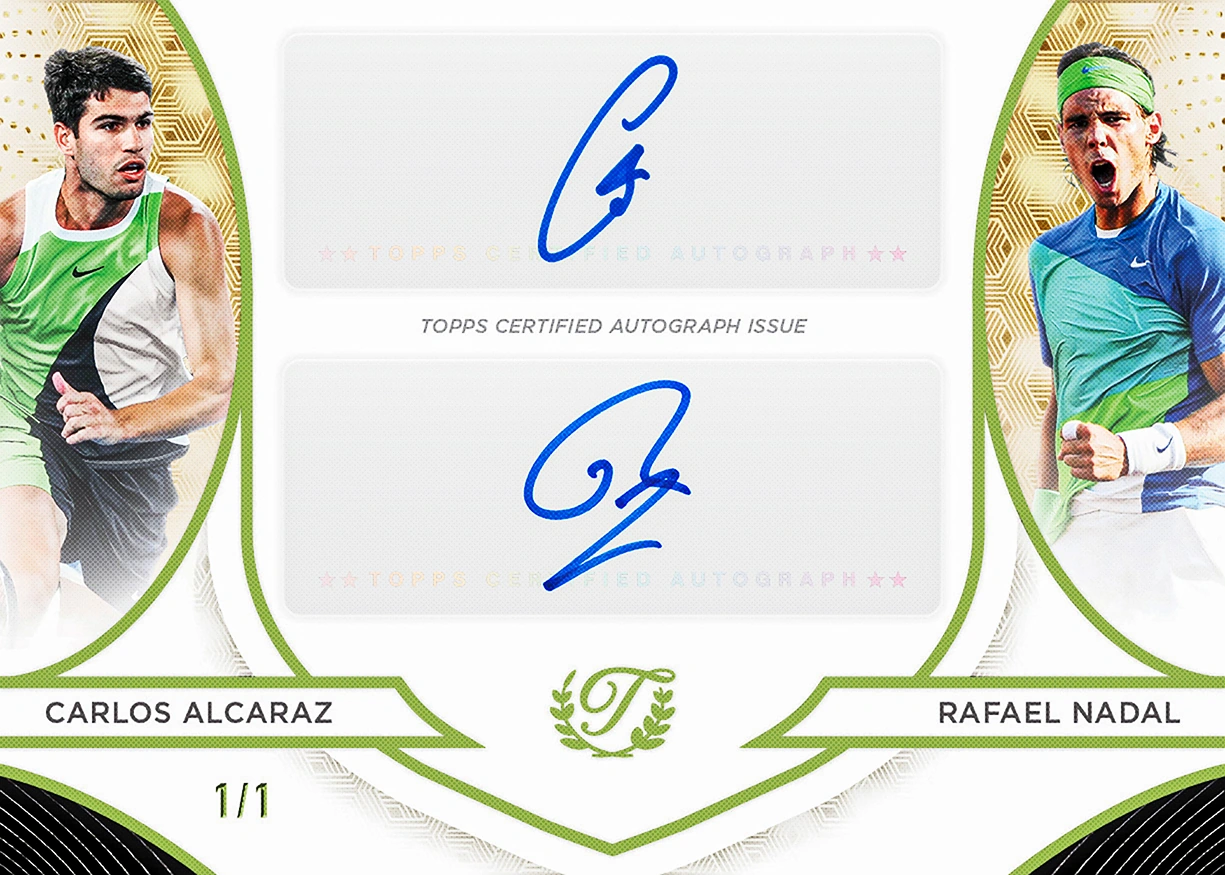
Carlos Alcaraz's pictured 1/5 autograph is the cleanest single-card example. The yellow shirt and ball stand sharply against the red field, while the pale panel below keeps the blue autograph from disappearing into the photograph. The card uses its portrait space for movement rather than a static pose, then gives the signature an unmistakable home beneath it. That is exactly the balance a modern tennis autograph needs.
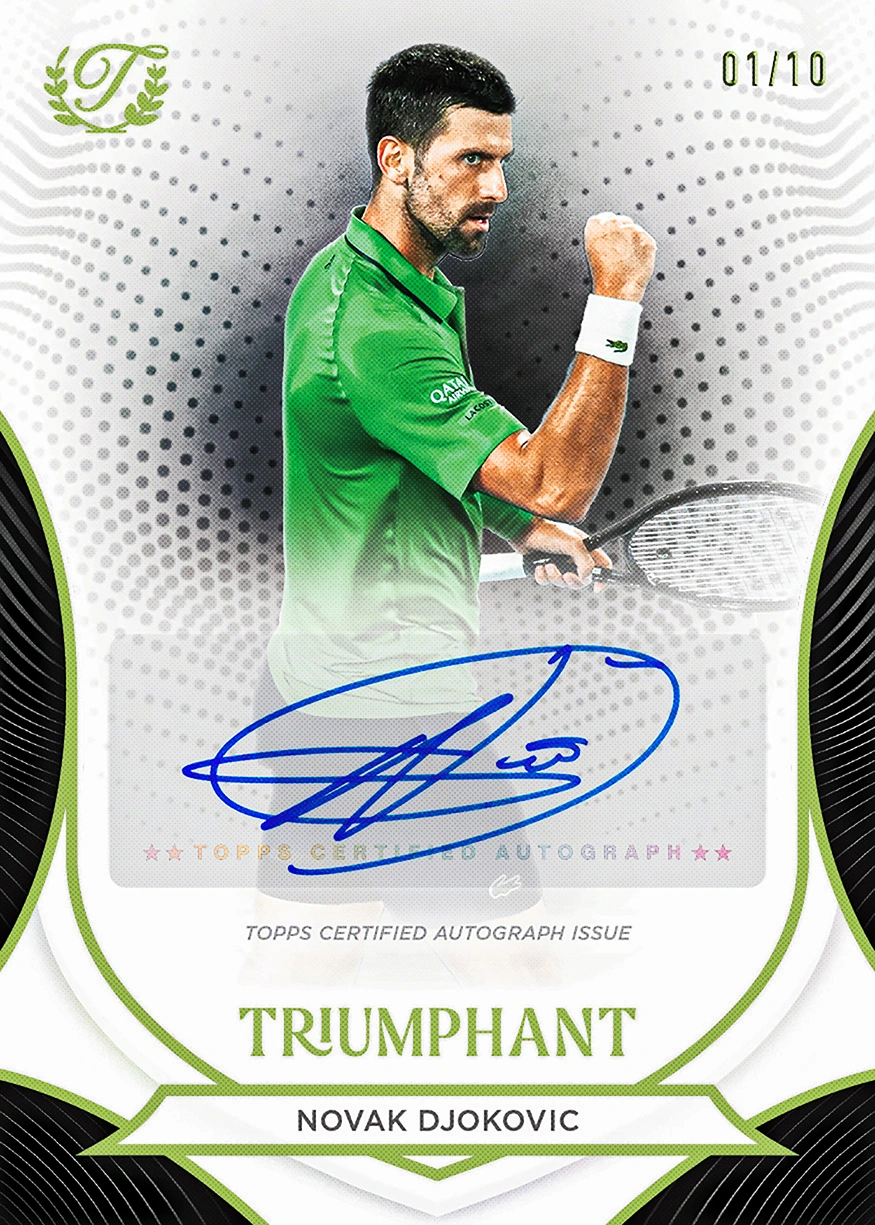
The Novak Djokovic 01/10 preview follows the same basic structure with a different mood. Djokovic's clenched fist and green shirt sit against a charcoal field, producing a more concentrated, dramatic image. The blue signature still has a pale area behind it, so the handwriting reads immediately rather than becoming another layer in the design. The shared border treatment lets Alcaraz and Djokovic look like part of one card family without forcing identical visual energy on both players.
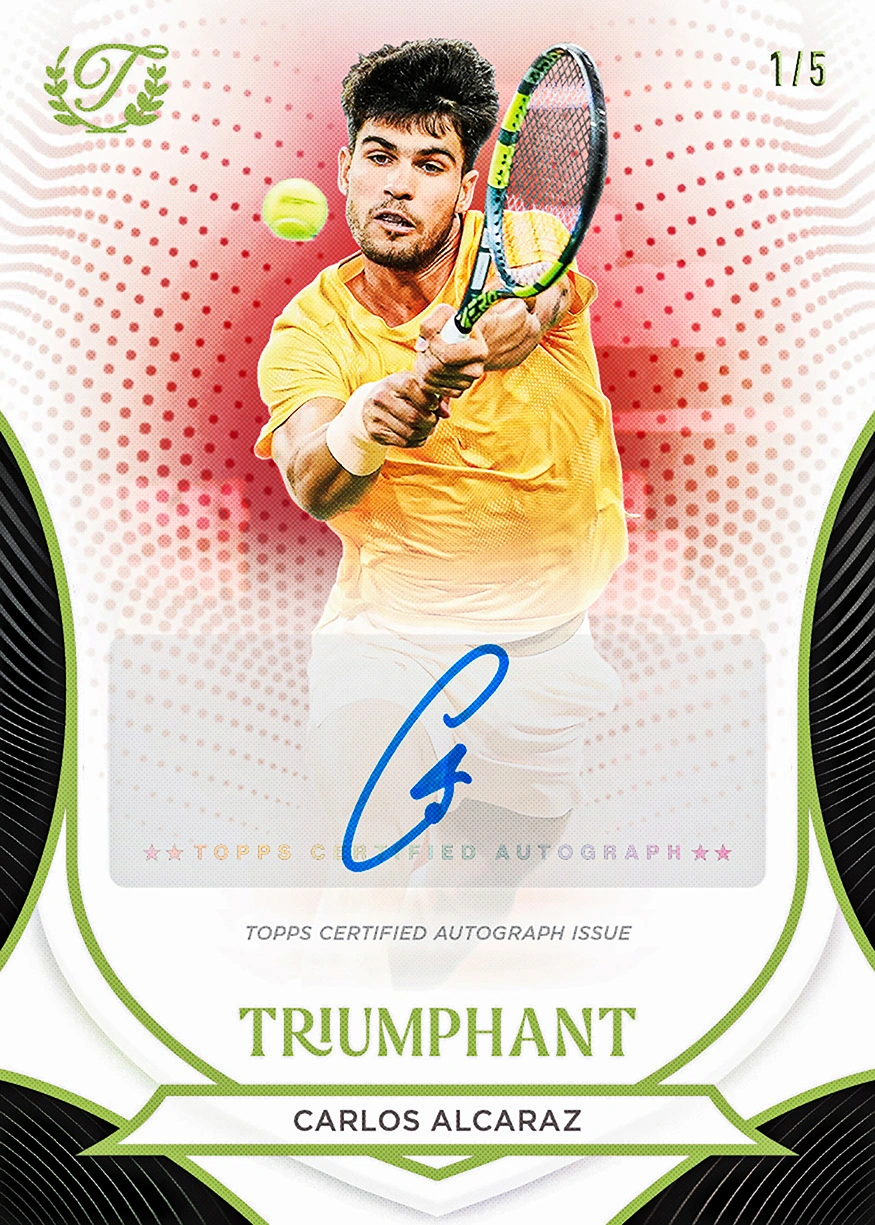
The Alcaraz/Rafael Nadal 1/1 preview is the strongest composition among the images here. Both players are held at the outer edges, leaving two separate central panels for their blue signatures. The white field, green framing and gold geometric detail make the pairing feel formal without making it stiff. It is a card built around two distinct images and two distinct autographs; neither player is reduced to a supporting role.
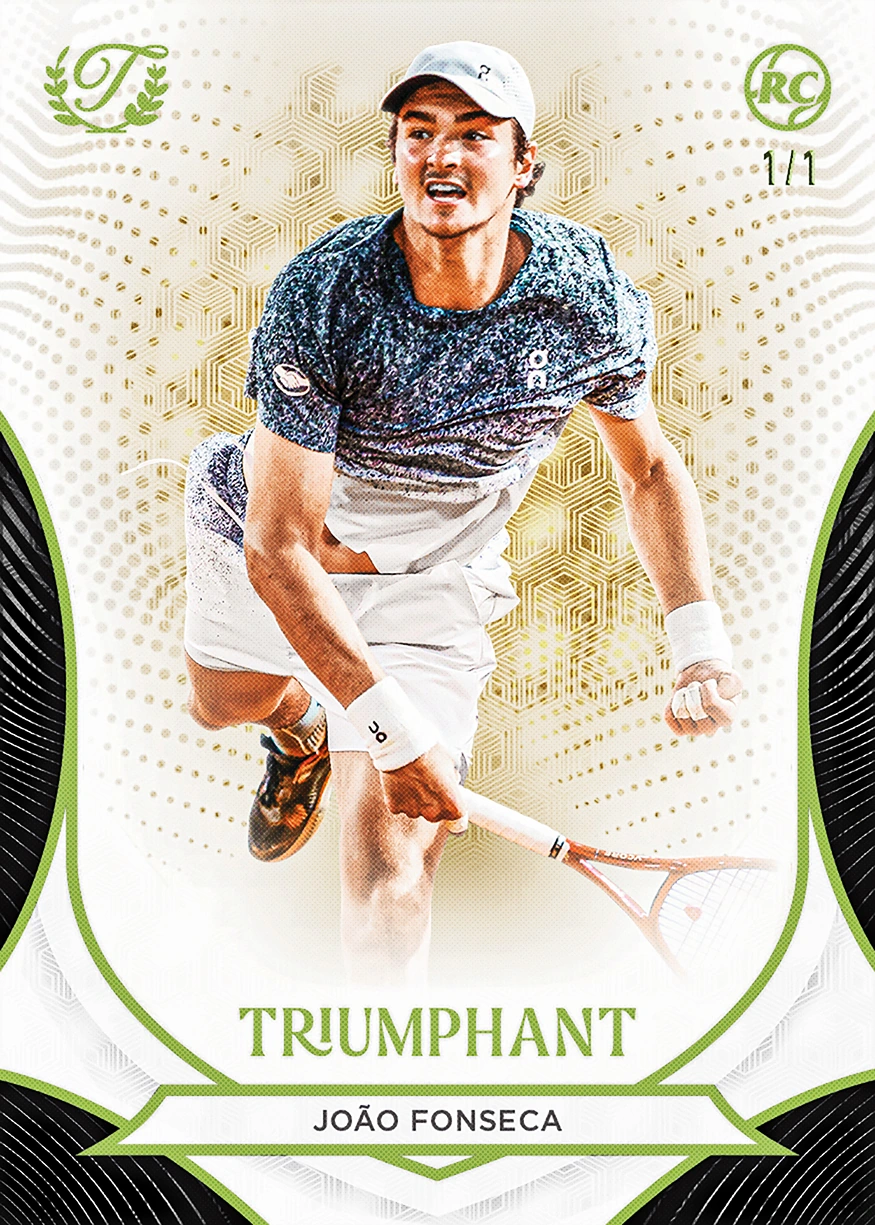
The João Fonseca 1/1 rookie preview takes the opposite approach. Fonseca fills the vertical design, driving through the center with racket low and body leaning forward. Gold patterning behind him supplies texture, while the green rookie emblem and serial number stay legible at the upper right. It is a convincing example of an unsigned card using action photography to carry the visual weight on its own.
Steffi Graf's Australian Open record gives a legend card real substance
Steffi Graf's collecting appeal starts with the kind of résumé that remains vivid even when reduced to one portrait or one signature. The Australian Open records four titles for Graf: 1988, 1989, 1990 and 1994. Her 1988 victory over Chris Evert began the Golden Grand Slam, the sweep of all four majors plus Olympic gold in the same calendar year. That is not vague legacy; it is a precise achievement that gives a Graf card a real historical center. Australian Open: Steffi Graf
The Melbourne record also shows why different Graf images can evoke different moments without requiring a card to print every accomplishment on its front. In 1989, she reached the final having lost only 16 games; in 1990, she closed the final against Mary Joe Fernandez without surrendering another game after falling behind 4-1 in the second set. Her 1994 final win over Arantxa Sánchez Vicario was 6-0, 6-2 and secured her 80th singles title. Australian Open: Steffi Graf
For a tennis-card collection, that depth makes Graf more than a famous name. A well-composed card can stand for a player whose success spanned repeated Australian Open titles, an Olympic gold medal and a season that sits alone in the sport's history. The right Graf card does not need an inflated story around it; the player already supplies one.
Martina Navratilova makes grass-court greatness collectible
Martina Navratilova gives a tennis collection a different, equally specific landmark. The WTA credits her with nine Wimbledon singles titles and 120 Wimbledon match wins, both the most by any player in the Open Era. Her nine titles are also the most by a woman at a single Grand Slam in that era. A card of Navratilova has immediate meaning because it can point to the sport's most enduring grass-court standard. WTA: Navratilova's grass-court reign
The beginning of that run is as memorable as the totals. At 16, Navratilova and Renata Tomanova arrived in London after their Queen's Club entries failed to reach the draw during an Italian postal strike. They found practice time at a local club near Wargrave, then Navratilova played her first Wimbledon match the following week. She won Wimbledon for the first time in 1978 and added eight more titles. WTA: Navratilova's grass-court reign
That arc is why landmark tennis cards work best when the design leaves room for the athlete. The Triumphant previews do that well: a collector can see the player, read the autograph when present, and let the accomplishment supply the lasting context. The Alcaraz/Nadal dual is the standout visual of the available images, while the Alcaraz, Djokovic and Fonseca examples show that the frame can handle sharply different kinds of player photography.
Shop this guide on eBay
Hammy earns from qualifying purchases through these eBay links. Buy on eBay from the seller shown in each listing.
Explore on eBay
Targeted searches for the cards and releases Hammy covers. Search results may include other formats or variants; match the listing to the card or box you want.
eBay search · Sealed wax
2026 Topps Triumphant Tennis
Search on eBay